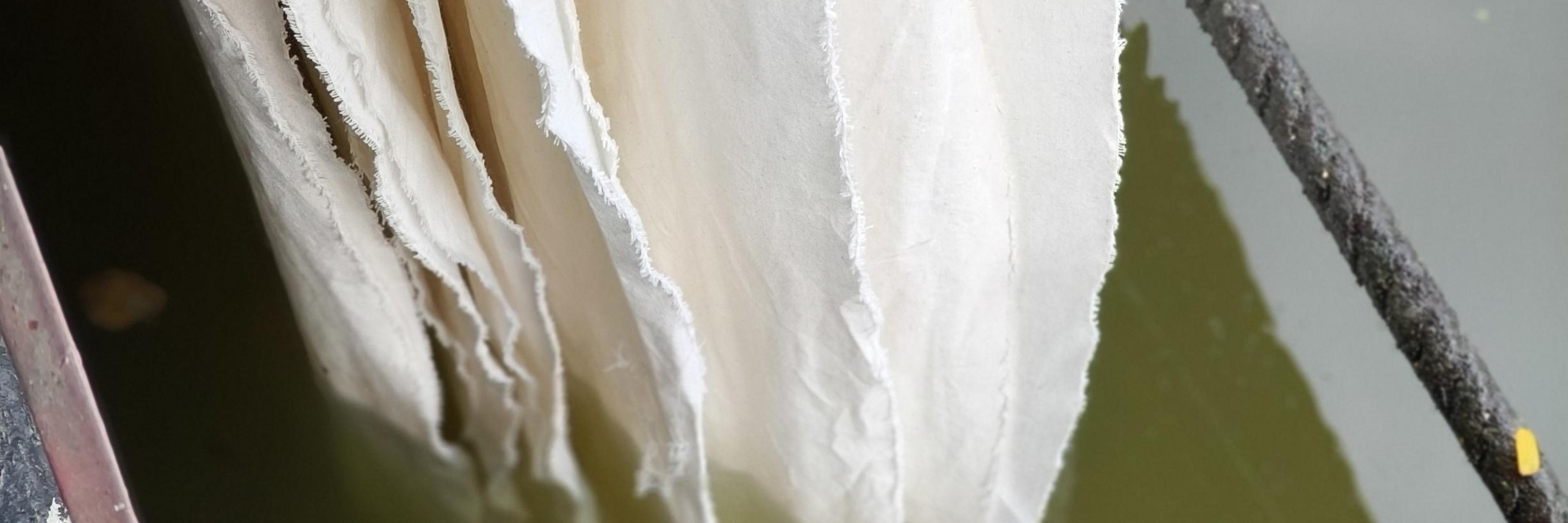
Interdisciplinary Weavings
This research project explores the transformation of narratives from the Tẻ Canal (Kênh Tẻ) in Ho Chi Minh City (HCMC) into an experimental textile installation shown from 13th - 17th April 2026 capturing the essence of daily life and environmental interactions surrounding this vital waterway. The research adopts a co-creative practice approach, involving four academics specialising in various creative disciplines, including film, sound, spatial design, digital media, and data visualisation. By drawing from researchers place experiences culminating in various creative disciplinary interpretations such as mappings, films and soundscapes, which later come together to create one installation the project highlights the intricate relationship between the canal and the urban landscape, establishing a vital record that supports the recognition of HCMC’s everyday spaces as significant cultural heritage.
By Dr Andrew Stiff, Thierry Bernard, Bin Youn, Dr Rachel Jahja.
Through the medium of textile (28 x 1m of calico), the project reinterprets these interpretations into abstract physical and digital representations, celebrating textiles as a traditional storytelling medium that can work with cinematic expression. The installation serves to spatialise and elevate the canal as an important heritage space while simultaneously encouraging a perception of the canal as an interconnected environment influenced by various temporal and spatial interactions.
This initiative plays a key role in the preservation of cultural narratives, ensuring that the importance of the TẻCanal is acknowledged and appreciated by future generations. By acting as a focal point for community engagement, the installation prompts the audience to reflect on their relationship with the canal and its evolving significance in HCMC’s urban landscape.
Furthermore, by bridging creative disciplines, place studies, and cultural heritage through interdisciplinary collaboration, the project fosters diverse viewpoints on the narratives that shape our understanding of place and heritage.
Acknowledgements: We would like to sincerely acknowledge The Coffee Ship for its generous support of our research inquiry. Your provision of access to the hanging fabric along the Kênh Tẻ Canal for a prolonged period enabled sustained engagement with the site and significantly strengthened our practice-based learning and documentation.
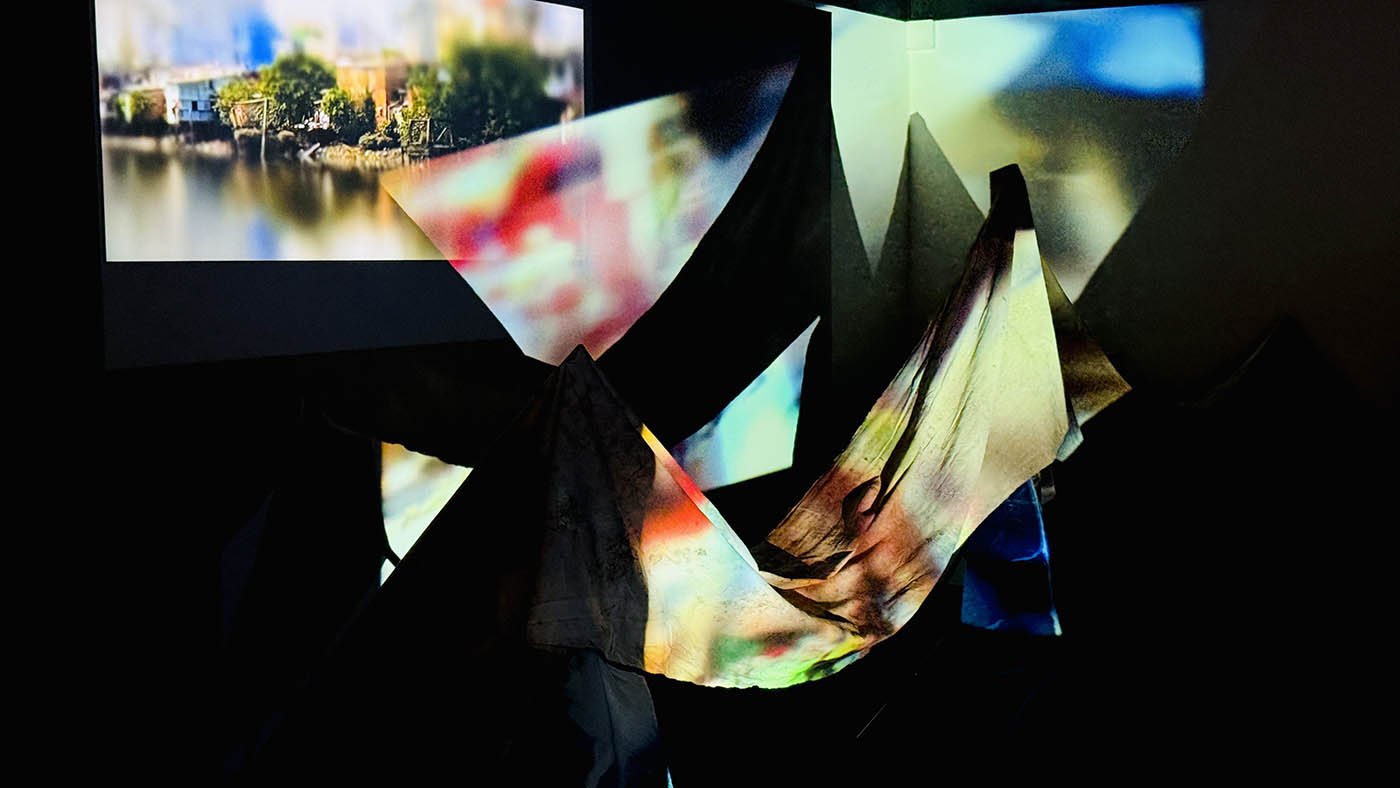
Figure 1: Video projection across the 28 x 1m calico, which was stained in sections by dipping it into the canal.
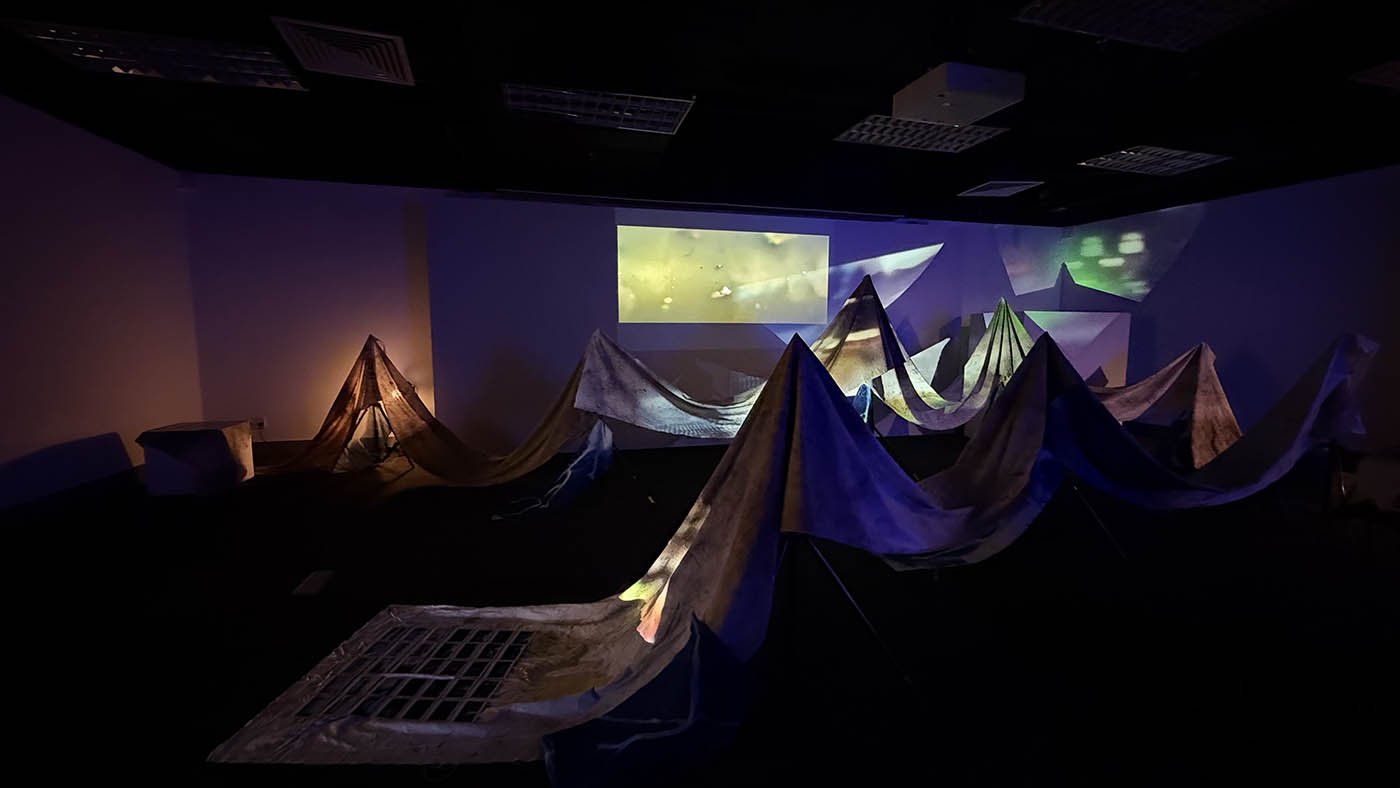
Figure 2: Video projection across the 28 x 1m calico, which was stained in sections by dipping it into the canal.
Knots As Quantisation [Kênh Tẻ Canal] / KAQ-KTC by Thierry Bernard
KAQ-KTC is a sound work that explores how environmental recordings, data, and images can be combined to generate autonomous sonic compositions and visual prints. The project does not aim to reproduce the canal as it is heard, but instead to transform its presence across different media. It begins with an act of listening: underwater recordings were made from a stationary ship—The Coffee Ship—capturing the submerged acoustic environment of the river at a specific moment. These recordings form the initial material of the work.
The process then shifts from sound to data and image. The underwater recordings were analysed through coding in order to extract a set of parameters, which were organised into a CSV file. This dataset was not treated as a final output, but as an intermediate layer. Using Python coding language, the data was then used to generate visual renderings derived from a topview photograph of the sectioned area. In this way, the project moves across media: from recorded sound to data, from data to image, and from image back to sound. In the final stage, the CSV file was imported into a program to generate audio synthesis and algorithmic composition named SuperCollider, where each parameter was mapped to sonic behaviours such as amplitude, pitch, spectral brightness, spatial movement, high-band, and so on...
The outcome is a series of three visual prints based on the notion of sound to data to visual, and a series of generated audio tracks that evolve autonomously over time. These sounds do not directly resemble the original recordings but instead form a synthetic acoustic environment shaped by the transformations applied throughout the process. The project proposes a simple but layered method: recording, extracting, translating, and re-synthesising. Through this chain, the canal is not represented but re-articulated, re-interpreted, allowing its presence to emerge as a dynamic and abstract visual to sonic experience.
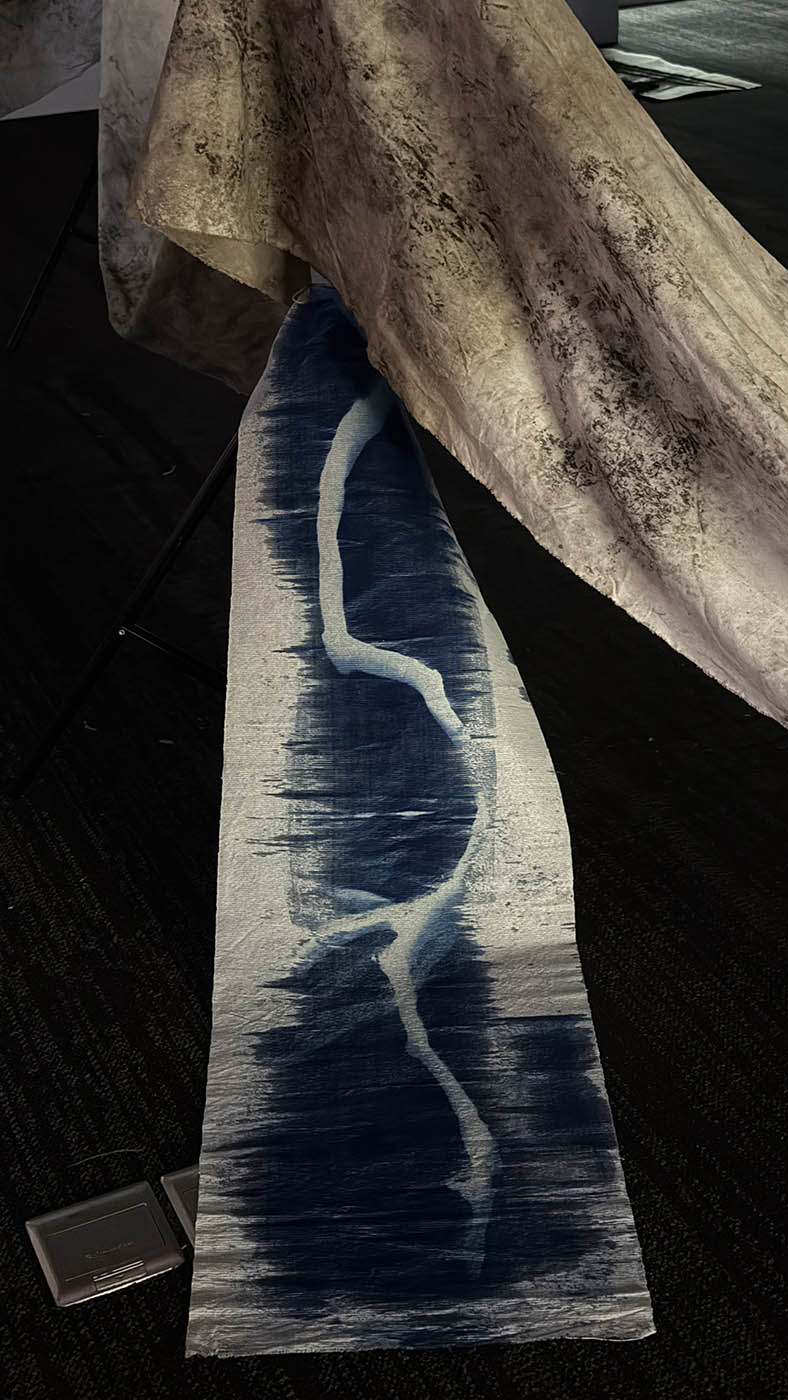
Figure 3: Detail of calico, and cyanotype.
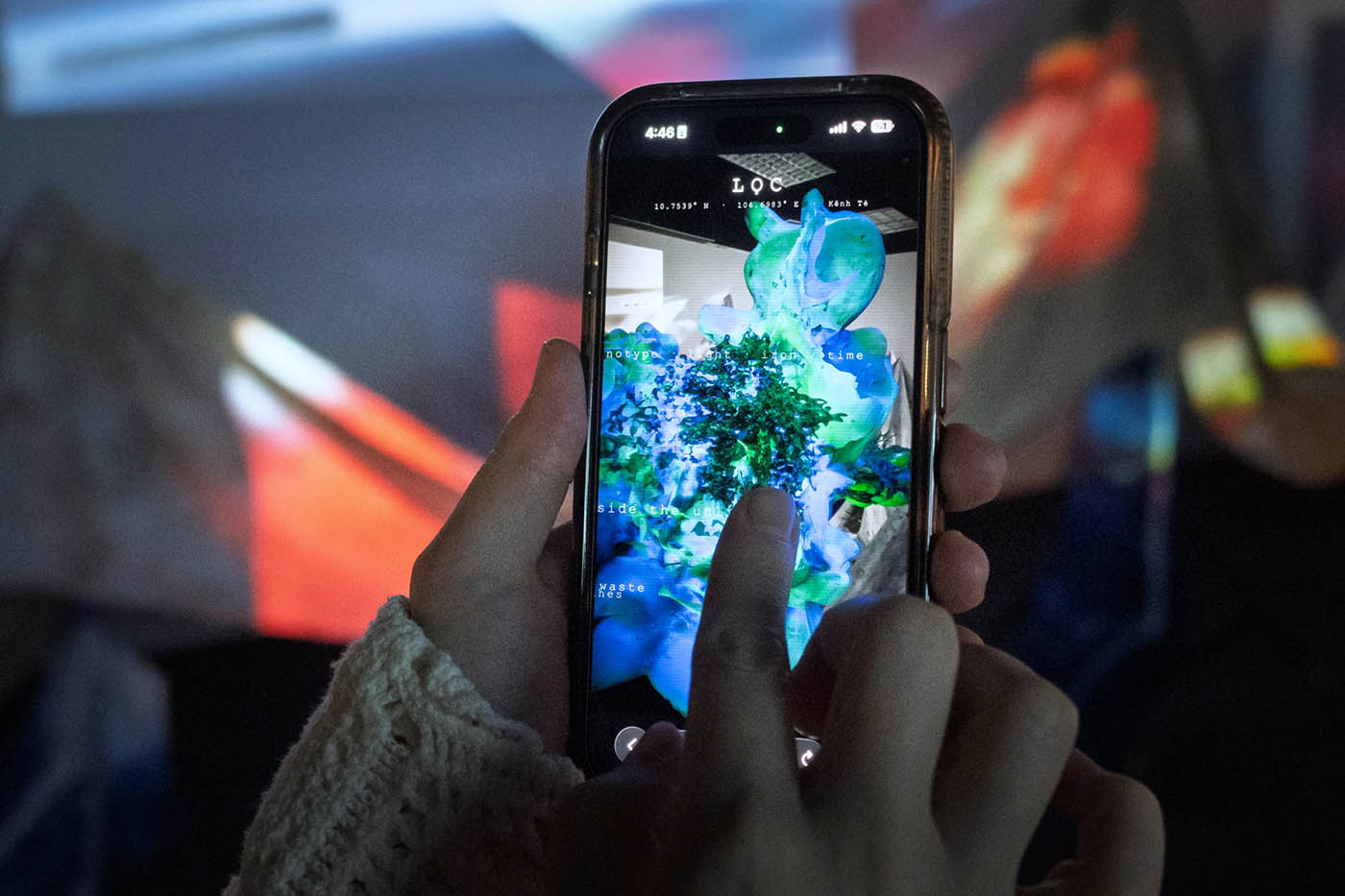
Figure 4: Augmented Reality.
Lọc (Filter · Strain · Purify) by Bin Yuon
Lọc (Filter · Strain · Purify) is a site-specific WebAR installation made for the Tẻ Canal, Kênh Tẻ, Ho Chi Minh City. The work is a contribution to the collaborative group installation Fabric Narratives, presented at the 28th IFFTI 2026 conference at RMIT University Vietnam.
The work asks what it means to filter — to receive, to pass through, to leave residue. At the canal's edge, objects accumulate: discarded plastic, sun-bleached shells, fallen coconuts. These are not waste as failure. They are the canal's vocabulary — matter in slow transformation, filtered through water, time, and human proximity.
Three objects found at the site are reconstructed as 3D digital models — green coconuts, canal shells, a plastic trash bag caught against a fence — and placed in an invisible triangle in AR space. Visitors navigate by touch: a liquid, drifting drag through open space, no arrows, no instructions. The camera feed is rendered alien — desaturated, blue-shifted, the world seen as if through a membrane. As each model is enlarged by pinching, it becomes translucent, see-through, the boundary between object and atmosphere dissolving
A poem overlays the space in fragments — GPS coordinates, bilingual site words, embodied sensing — written from the position of the body as primary instrument. The skin before the pixel. Contact before capture. The pore, not the lens.
Lọc treats the body as a filtering apparatus: sensing before naming, receiving before framing. The canal does not need to be beautiful. It needs to be attended to.
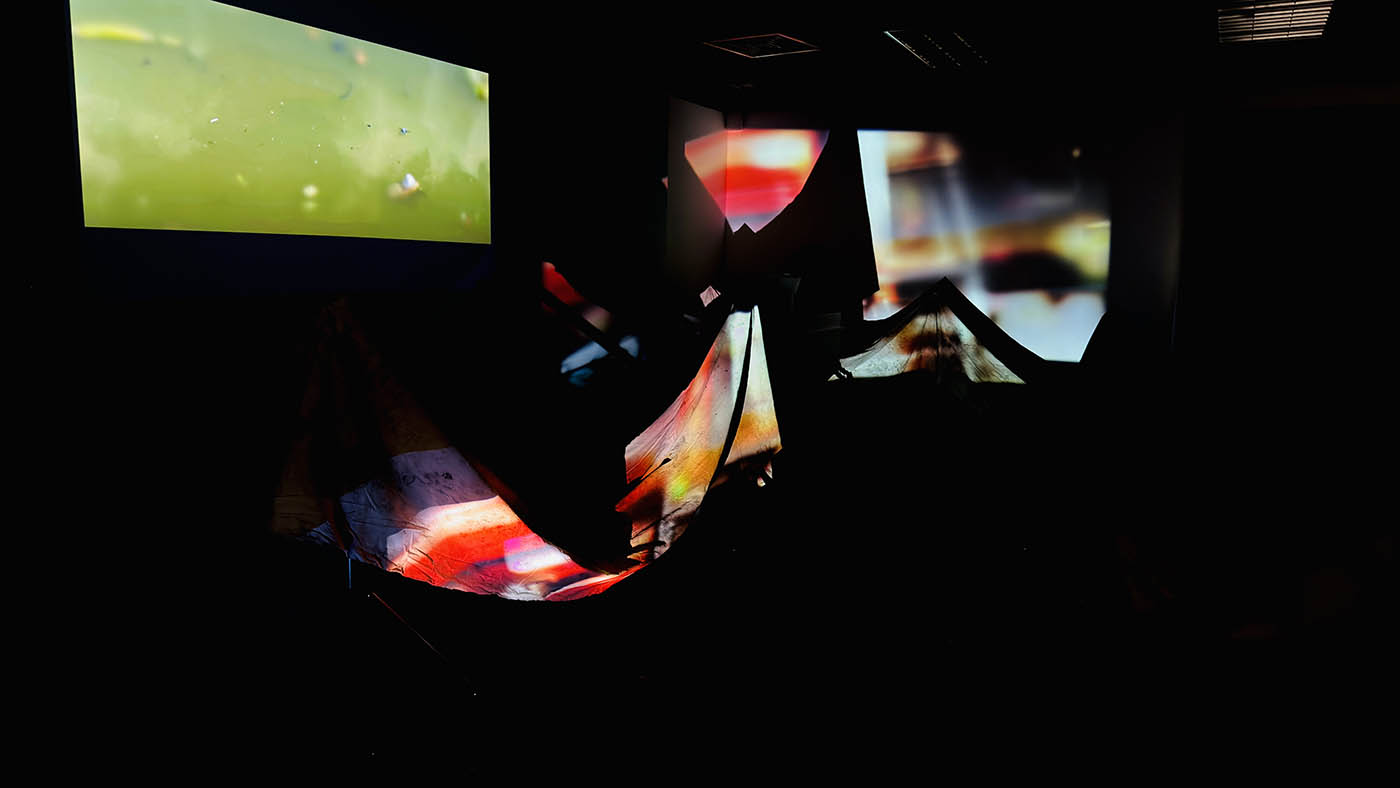
Figure 5: Video projection
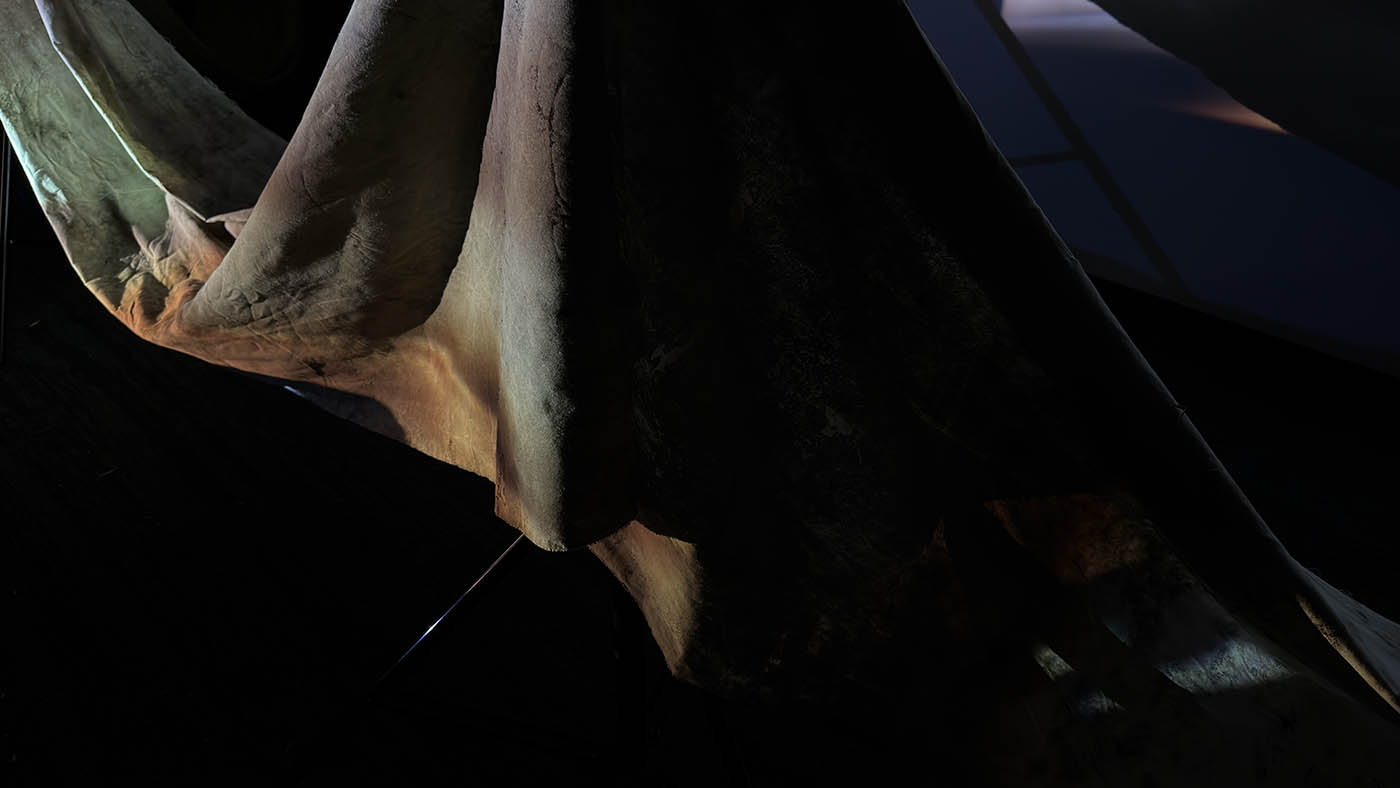
Figure 6: Detail of calico
Kenh Te: Two Tides Two Flows by Dr. Andrew Stiff
Kênh Tẻ: Two Tides Two Flows' is a two-channel video installation that maps the flow of the Tẻ Canal and the Tôn Thất Thuyết street market running along the canal’s north bank. The temporal mapping of these two spaces reveals the complex and symbiotic relationship between the local community and the canal’s nature-based environments. In particular, the rhythm of each space reveals an identity forged through everyday events, whether human-made or nature-made, micro or planetary in scale.
The two films were presented through dual projections. The canal film was projected onto one wall of the exhibition space. This decision was informed by the nature of the footage, which focuses on the surface of the water. The film is gentle and subtle, much like the canal itself, with a tempo determined by planetary systems. The canals and waterways of Ho Chi Minh City are tidal, and the moon heavily influences the scale of the high tide, often causing flooding in neighbouring streets during a full moon. The canal footage struggled when projected across the dipped canvas, but worked far more effectively on a flat wall, where its gentleness remained intact. In contrast, the second film, depicting the street market, was heavily edited, layered, and saturated. Its projection across the dipped canvas, and interaction with the cyanotype, brought the installation together through movement and the intensity of colour.
The video components of the installation complemented the sonic and physical environments. The work demonstrated how the tempo, colour, and content of moving-image sequences can build distinct and intricate relationships with spatial and sonic arrangements, even when the different elements were developed with minimal collaboration beyond the 25-metre canvas and the installation process itself.